
An honest, practical guide to earning money from home when you have children to look after, little or no spare cash, and need to make your money go further.
If you’re a mum searching for ways to make money online with no money to invest, there’s a good chance you’re not looking for a glamorous new business or a promise of becoming rich.
Perhaps you’re trying to make the household budget stretch a little further. Maybe you’re looking after young children and cannot easily take a job outside the home. Perhaps you’re a single mum, returning to work after having a baby, or trying to find a way to contribute financially without paying for childcare.
You might have only an hour or two available each day. You might not have much experience with computers. And spending £100 on a course, website or business opportunity may simply be out of the question.
First, there’s something important to say: you do not need to spend money to begin exploring ways to earn online. But you do need to be careful. There are genuine opportunities, there are options that take considerable time to become worthwhile, and there are people who deliberately target financially pressured parents with unrealistic promises.
This guide will help you tell the difference.
It will look at practical ways to start without paying upfront, what each involves, how to avoid scams, and how to choose an approach that fits around family life. It will also be honest about what you can and cannot expect.
The honest answer: where can you start without spending money?
There are two broad routes:
- Get paid for work you do. This is usually the more practical route if you need money sooner. Examples include remote customer service, administration, tutoring or freelance services.
- Build something that might earn money later. Examples include affiliate marketing, a blog, a YouTube channel or selling digital products. These can be done with little or no initial spending, but they are uncertain and often take months of consistent work before earning anything.
If you need money for food, rent, electricity or nappies this week, I would not advise relying on a new online business. Look first at paid work and any support you may be entitled to. You can explore a longer-term online business alongside that, if your time and circumstances allow.
Here is how the main possibilities compare.
| Option | Can you start free? | How quickly might you earn? | Main difficulty |
|---|---|---|---|
| Remote customer service | Yes, when applying directly | Depends on recruitment and payroll | Fixed shifts may be required |
| Online administration | Yes, when applying directly | Depends on finding a job | Requires organisation and computer skills |
| Freelance services | Usually | Potentially sooner with a client | Finding the first client |
| Online tutoring | Usually, if you have suitable skills | Depends on finding pupils | Subject knowledge and availability |
| Selling unused belongings | Yes, using existing items | Potentially relatively quickly | Not a long-term income source |
| Online surveys and user testing | Usually | Small, irregular amounts | Limited opportunities and low earning potential |
| Affiliate marketing | Can be started free | Often slow and uncertain | Building an audience and generating sales |
| Blogging or creating videos | Can be started free | Usually slow | Consistent content creation and audience growth |
The best starting point depends on whether you need money quickly, how many hours you can realistically work, and whether you have a computer or only a mobile phone.
1. Remote customer service: getting paid for your time

This is one of the first options I would investigate if you need a more predictable income.
Companies sometimes recruit people to answer customer enquiries by telephone, email or live chat. Some positions are fully remote; others are hybrid or require you to attend an office occasionally.
The work might involve:
- Answering customer questions.
- Helping people with orders and deliveries.
- Booking appointments.
- Handling account enquiries.
- Explaining products or services.
- Resolving straightforward complaints.
What do you need?
Usually, a reliable internet connection, a quiet enough place to work, a computer and good communication skills. Some employers provide equipment, but check this before accepting an offer.
Can you do it around children?
Sometimes, but be realistic. Telephone work usually requires uninterrupted periods. A toddler needing attention every few minutes may make a live telephone role difficult. Email or chat-based work may offer more flexibility, although employers still expect you to meet response times.
How to get started without paying:
Search established job sites for:
- Remote customer service adviser.
- Home-based customer support.
- Remote email support.
- Part-time customer service.
- Evening customer service.
Apply directly through the employer’s official careers website where possible. Never pay someone to secure an ordinary job for you.
2. Online administration: useful if you are organised
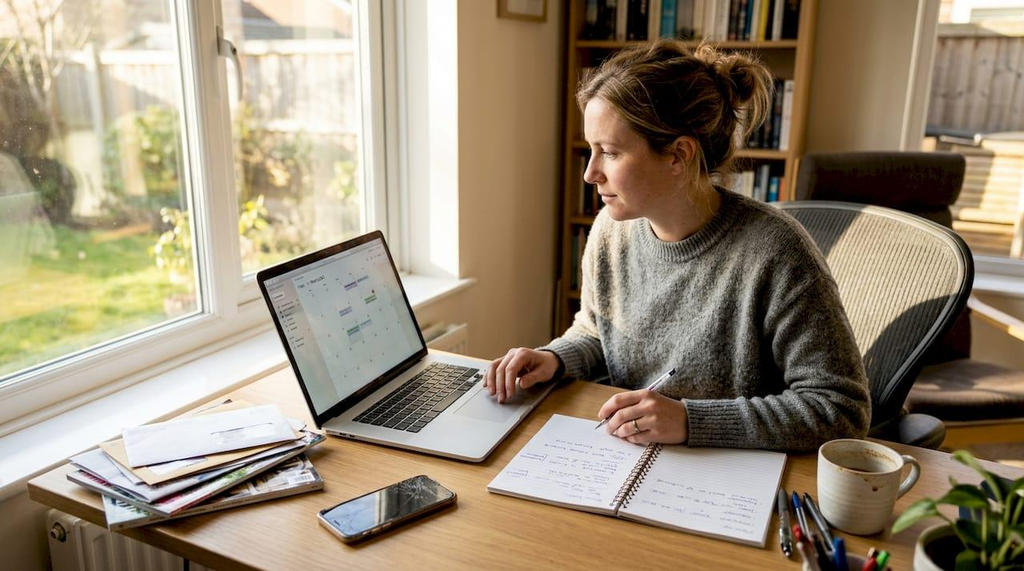
You do not necessarily need a business degree or years of office experience to undertake basic administrative work.
Small businesses and independent professionals sometimes need help with:
- Managing email enquiries.
- Booking appointments.
- Updating spreadsheets.
- Organising documents.
- Preparing simple reports.
- Maintaining customer records.
- Scheduling social media posts.
Some of this work is advertised as remote administration or virtual assistant work.
A virtual assistant is simply someone who provides administrative support remotely.
Could you do this with no experience?
Possibly. Start by identifying things you already know how to do.
Have you organised school activities, managed appointments, kept household records, arranged family events or handled correspondence? These experiences do not automatically make you a professional administrator, but they may give you transferable skills.
You could practise using free versions of tools such as Google Docs, Google Sheets and Google Calendar.
Do not buy a virtual assistant course before checking whether you actually enjoy the work and whether employers or clients are interested in your services.
3. Freelancing: turn a skill you already have into a service

Freelancing means offering a service to clients and being paid for completing it.
You do not need to invent a product or become an influencer. You need to identify something useful that another person or business is willing to pay you to do.
Examples include:
- Proofreading and checking documents.
- Writing product descriptions.
- Creating simple social media graphics.
- Editing short videos.
- Preparing presentations.
- Data entry.
- Transcribing clear audio recordings.
- Organising spreadsheets.
- Writing newsletters.
- Basic website updates.
You might be surprised by how many useful skills you already possess.
An example
Suppose you are comfortable creating simple graphics using Canva.
A local hairdresser might need help producing a few social media posts each week. A small business might need a menu redesigned. A self-employed tradesperson might need help creating a simple price list.
You could offer one clearly defined service rather than advertising yourself as someone who can do everything.
A sensible way to begin:
- Choose one service you can confidently deliver.
- Create two or three examples of your work.
- Put together a simple portfolio using a free online document or page.
- Contact a small number of relevant businesses professionally.
- Agree the work, price, deadline and payment arrangements in writing.
Do not work for weeks without agreeing payment. Be wary of clients who ask you to complete substantial unpaid test projects.
4. Online tutoring: useful if you have knowledge to share

If you are confident in a school subject, language, musical instrument or another skill, online tutoring may be worth exploring.
Possible subjects include:
- Primary-school English and maths.
- GCSE subjects.
- Languages.
- Reading support.
- Music.
- Computer skills.
- Adult learning.
You may be able to teach using free video-calling software, although established tutoring platforms may charge commission or have their own terms.
Think carefully about safeguarding, appropriate checks, platform rules and whether you have the knowledge to teach the subject competently.
If you have no teaching experience, start with a subject you know well rather than promising results you cannot guarantee.
5. Selling things you no longer need
How to sell baby and kids clothes on Vinted: the complete 2026 guide | Vintedify

This is not really an online business, but it may be one of the quickest ways to generate some money without investing anything.
Look around your home.
Are there:
- Children’s clothes that no longer fit?
- Toys in good condition?
- Books you have finished reading?
- Unused household items?
- Baby equipment you no longer need?
You could list suitable items on established second-hand marketplaces.
Take clear photographs, describe the condition accurately and check the platform’s fees, postage arrangements and collection safety.
There is an important limitation: once you have sold the things you no longer need, that source of income runs out. Treat it as a possible short-term cash boost, not a reliable monthly income.
6. Online surveys and user testing: can they make money?
You have probably seen adverts promising money for answering surveys, testing websites or giving opinions.
Some legitimate research companies do pay participants. However, this is generally better viewed as occasional supplementary money than a dependable income.
Online surveys
You answer questions about products, services, habits or opinions.
The problems are:
- Some surveys pay very little.
- You may be screened out after answering initial questions.
- There may be limited surveys available.
- Payments may require reaching a minimum withdrawal threshold.
Website and app testing
Some companies pay people to try websites or apps and describe their experience.
You may be asked to:
- Find a particular page.
- Complete a task.
- Explain whether something is confusing.
- Record your screen and voice.
This can pay better per individual task than many surveys, but opportunities are not guaranteed and may require a computer, microphone or particular demographic profile.
My advice: never pay to join a survey panel, never treat surveys as a replacement for employment, and do not spend hours chasing a tiny reward.
7. Affiliate marketing: building an online income without creating a product

This option deserves a proper explanation because it is often presented in misleading ways.
Affiliate marketing is a business arrangement in which you recommend another company’s product or service using a special tracking link. If someone makes a qualifying purchase through that link, you may receive a commission.
You do not normally need to:
- Manufacture a product.
- Hold stock.
- Package orders.
- Arrange deliveries.
- Handle the product’s customer service.
However, you do need to attract people who are genuinely interested in what you recommend.
How could a mum start affiliate marketing without money?
Imagine you are interested in helping other parents save money.
You might create useful articles or videos about:
- Affordable baby equipment.
- Budget-friendly family meals.
- Ways to organise a busy household.
- Low-cost educational activities.
- Products that make parenting easier.
- Honest comparisons of household essentials.
If a relevant company has an affiliate programme, you could apply and, if accepted, include disclosed affiliate links where they genuinely help readers.
You can start creating content using free tools. You do not have to purchase a website immediately: free publishing platforms and social media can help you test whether you enjoy creating useful content.
But how much money can you make?
This is where I want to be particularly honest.
You might earn nothing for quite some time.
You could write ten useful articles and receive very little traffic. You could build a social media following without generating sales. You could receive clicks but no commissions.
There is no guaranteed income and no reliable timetable for success.
Affiliate marketing is not a sensible solution if you need money by Friday. It is a possible longer-term project for someone who can invest time without depending on immediate returns.
What does it cost?
You can begin with:
- A phone or computer you already own.
- An internet connection you already pay for.
- Free content-creation tools.
- Free publishing platforms.
- Affiliate programmes that do not charge an application fee.
You may eventually decide to pay for a domain name, website hosting or other services, but none of those should be your first purchase.
My recommendation: learn how the process works and publish some genuinely helpful content before spending a penny.
8. Blogging and creating helpful content

Perhaps you enjoy writing, explaining things or sharing what you have learnt.
A blog can be a way to turn that interest into something useful for other people.
For example, a mum who has spent years finding affordable ways to entertain children might write about:
- Free activities for children during school holidays.
- Low-cost birthday party ideas.
- How to organise family meals on a tight budget.
- Affordable school uniform options.
- Practical tips for managing a household.
The key is to write about subjects you understand and can genuinely help people with.
A blog can eventually earn money through advertising, affiliate commissions, sponsorships or selling your own products. But these income sources generally require readers, trust and consistent work.
You should not assume that publishing articles automatically produces visitors. Search engines take time to discover and assess content, and social media audiences take time to build.
Do you need to buy a website?
No. You can begin by publishing on a free platform or creating useful posts on a social media account.
A paid website can give you more control over your content and branding later, but it is not essential for testing your idea.
I would rather see you publish five genuinely useful articles for free than spend money on a website before you know what you want to write about.
9. Creating short videos without showing your face

You do not have to become an influencer or film yourself talking to a camera.
You could create short videos showing:
- Simple, inexpensive family meals.
- Ways to save money on household essentials.
- Children’s activities using things already at home.
- Organisation tips for busy parents.
- Honest reviews of products you already own.
- Useful lessons you have learnt as a parent.
You could use photographs, captions, screen recordings or footage of everyday activities.
The important thing is that the content is yours, useful and honest. Do not copy other people’s videos or use misleading claims to attract attention.
You can start with a phone and free editing software. There is no need to buy expensive cameras, lighting or editing subscriptions.
However, creating videos consistently takes time, and views do not automatically translate into income.
10. What if you only have one hour a day?
This is a particularly important consideration.
A mother with a baby, a school-age child and household responsibilities may not have the same availability as someone working from home without caring responsibilities.
You might have an hour after the children go to bed. You might have 20 minutes during a nap. Some days you may have no time at all.
Rather than choosing an opportunity that demands a fixed schedule, consider what you can realistically sustain.
Here are three possible approaches.
If you have 20–30 minutes a day
Focus on one small task: applying for a suitable remote job, preparing a freelance sample, listing an unused item or researching one genuine opportunity.
If you have about one hour a day
You could build a small portfolio, contact potential clients, complete a freelance task or create one useful piece of content.
If you have two or more hours a day
You may be able to consider part-time remote employment, regular freelance work, tutoring or a more structured content project.
The right approach is not necessarily the one with the highest theoretical earning potential. It is the one you can actually manage alongside your family responsibilities.
11. A realistic 30-day plan for starting with no money
You do not need to launch a business, create a website, join ten platforms and master social media in your first week.
Start small.
Days 1–3: Work out what is possible
Write down:
- How many hours you can realistically spare.
- Whether you have a laptop or only a phone.
- Whether you need money immediately or can build something over time.
- What skills you already have.
- Whether you can work uninterrupted or need completely flexible hours.
Choose one immediate-income option and, if you wish, one longer-term option.
For example, you might apply for remote customer service work while exploring whether you enjoy writing useful content.
Days 4–7: Take your first practical steps
Depending on your chosen route:
- Update your CV and apply for suitable remote roles.
- Prepare a sample of your administrative or writing work.
- List a few unwanted household items for sale.
- Research legitimate tutoring opportunities.
- Publish your first useful article or video.
Do not spend money trying to look like an established business before you have done any work.
Week 2: Find out whether there is genuine demand
If you are looking for employment, continue applying and improve your applications.
If you are freelancing, contact a small number of relevant potential clients.
If you are creating content, publish another useful piece and pay attention to the questions people ask.
The purpose of this week is to find out whether people actually need what you are offering.
Week 3: Improve what you are doing
Look at what has happened.
- Have you received any job responses?
- Have potential clients shown interest?
- Are people asking questions about your content?
- Are you finding the work manageable around your children?
- Is the time involved worthwhile?
If something is not working, adjust it rather than automatically spending money on a course or subscription.
Week 4: Decide what deserves more of your time
At the end of 30 days, ask yourself:
- Which activity has the clearest route to earning money?
- Which activity fits around my children?
- Which activity can I continue without spending money?
- Have I seen any evidence that someone is willing to pay for what I offer?
- What should I stop doing because it is wasting time?
You do not have to turn every experiment into a business. Learning that something is unsuitable is useful progress too.
12. How to recognise work-from-home scams

When someone is short of money, an advert promising £500 a week from home can be extremely tempting.
Unfortunately, scammers understand this.
Some advertise fake jobs. Others sell expensive starter packages, worthless training or supposed business opportunities that make money only when you recruit more people.
The UK’s Report Fraud service specifically warns about work-from-home schemes involving advance fees, worthless products, unpaid work and recruitment of other participants. Report Fraud+1
Warning signs to look out for
| Warning sign | Why you should be cautious |
|---|---|
| You must pay to get a job | Genuine employers generally do not require an upfront payment to employ you |
| Guaranteed high earnings | No legitimate opportunity can guarantee substantial income regardless of your effort |
| You must recruit friends | You may be looking at a pyramid-style scheme |
| You must buy a starter kit | You may be paying for products or materials with little resale value |
| They will not explain the actual work | You cannot assess whether the opportunity is genuine |
| They pressure you to sign up immediately | Artificial urgency is a common sales tactic |
| They ask you to receive and transfer money | You could be drawn into money laundering or other criminal activity |
A particularly important point: a genuine recruitment agency in the UK cannot charge you a fee simply for finding you work. There are some exceptions for particular sectors and separately offered services, but paying for a job opportunity should make you cautious. GOV.UK+1
If you suspect a work-from-home scam, you can find guidance and reporting information at Report Fraud.
13. What if you are struggling financially right now?
I want to include this because it is easy for an article about earning money online to overlook something important.
If you are struggling to pay essential bills, a new online business may not be the answer to your immediate problem.
You may be entitled to support that you have not claimed.
In the UK, you can use the government’s free benefits calculators to check whether you might qualify for support and how starting work could affect your payments. GOV.UK
Depending on your circumstances, this might include:
- Universal Credit.
- Help with housing costs.
- Support with childcare costs.
- Council Tax Reduction.
- Other help linked to your household circumstances.
If you receive Universal Credit and start earning through self-employment, there are reporting requirements. You generally need to report your self-employed income and expenses for each monthly assessment period, even when you have earned nothing. The rules can also involve a minimum income floor, although eligible people may receive a start-up period. GOV.UK+1
Do not assume that earning a little extra automatically means you will lose all your benefits. Equally, do not assume that additional earnings will have no effect.
Check your own circumstances before making financial decisions.
Useful free resources include:
- GOV.UK benefits calculators – check what support you might be entitled to.
- MoneyHelper’s Universal Credit guide – understand how payments and earnings work.
- GOV.UK self-employment and Universal Credit – understand your reporting responsibilities.
- Report Fraud – understand and report work-from-home scams.
If you are struggling with debt or essential household costs, organisations such as Citizens Advice and StepChange may also be able to help you work through your options.
14. Frequently asked questions
Can I really make money online as a mum without investing anything?
Yes, it is possible to start without paying for a course, website or business package. You can apply for remote jobs, offer services, tutor online, sell belongings or create content using free tools.
However, starting for free does not mean earning is guaranteed. You will still need to invest time, effort and patience.
What is the quickest way to make money online as a mum?
If you need money relatively soon, I would investigate remote employment, freelance services or selling unwanted belongings before starting a blog or affiliate marketing business.
Employment offers a clearer route to being paid for hours worked, although recruitment takes time. Freelancing can also generate income, but finding your first client is often the hardest part.
Can I make £500 a month working from home?
It is possible, but it depends on the work, the hours available, your skills and whether you can find paying customers or an employer.
For example, earning £500 through paid employment is a different proposition from earning £500 through affiliate marketing. The latter requires people to discover your content and make qualifying purchases.
Do not plan your household finances around an income you have not yet established.
Can I work online while looking after a baby?
You may be able to, but consider the nature of the work.
Flexible tasks such as writing, creating content or completing certain freelance projects may be easier to fit around a baby’s routine than telephone customer service or scheduled online tutoring.
Remember that babies do not follow predictable timetables. Avoid committing to deadlines or working hours that you cannot realistically meet.
Do I need a laptop?
Not always. You can sell items, create social media content and undertake some online tasks using a smartphone.
However, a laptop is generally more practical for administration, writing, spreadsheets, online tutoring and many remote jobs.
If you only have a phone, start with opportunities that genuinely work on mobile rather than spending money on equipment before you have identified a suitable income source.
Can I make money online without showing my face?
Yes.
You can write articles, create graphics, manage social media accounts, provide administrative services, tutor through suitable platforms or make videos using demonstrations and captions.
Showing your face is not a requirement for most online work.
Is affiliate marketing suitable for a complete beginner?
It can be, provided you understand that it is a business-building activity rather than a quick way to earn money.
You need to understand the products you recommend, create useful content, attract an audience and disclose commercial relationships appropriately.
It is worth exploring if you enjoy helping people and can give it time without relying on immediate income.
Do I have to pay for a course to learn how to make money online?
No.
There is a substantial amount of free information available from government websites, libraries, established educational organisations and reputable online learning resources.
Be particularly cautious of courses that promise guaranteed earnings or suggest you must purchase their training before you can begin.
Can I make money online if I have no qualifications?
Yes. Some work requires formal qualifications, but many opportunities depend more on practical skills, reliability, communication and organisation.
Customer support, basic administration, selling unwanted belongings and some freelance services may not require formal qualifications.
Be honest about your experience and do not offer professional services that require qualifications you do not have.
Will earning money affect my Universal Credit?
It can. The effect depends on your household circumstances, earnings, work allowance and whether you are employed or self-employed.
Self-employed people claiming Universal Credit have particular reporting requirements. Check the official guidance and use a benefits calculator before making decisions. GOV.UK+2
Do I have to pay tax on money I earn online?
Potentially, yes. In the UK, the trading allowance can cover up to £1,000 of gross trading income in a tax year, subject to eligibility and other rules. If you earn more, or have other circumstances requiring a tax return, you may need to tell HMRC. Keep records of what you receive and spend. GOV.UK+1
What if I try something and it does not work?
That does not mean you have failed.
Perhaps the opportunity was unsuitable, the hours were unrealistic or there was not enough demand for the service you offered.
Review what happened. Did anyone respond? Did you enjoy the work? Was the time involved worthwhile? Could you change your approach without spending money?
You are allowed to stop doing something that is not working and try another route.
15. So, what would I recommend if I were starting from zero?
If I were a mum with children to look after, no spare money to invest and a genuine need to earn more, I would not start by buying a business opportunity.
I would take a simple, two-track approach.
Track one: Find a way to earn sooner
First priority
- Investigate part-time remote employment.
- Consider administrative or customer-support work.
- Look at freelance services based on skills you already possess.
- Sell suitable unwanted belongings if you need a short-term cash boost.
Track two: Build something for the longer term
- Choose a subject you understand and enjoy.
- Start publishing genuinely helpful information.
- Learn how to attract an audience.
- Explore possible income sources only when you understand how they work.
- Keep your costs at zero until there is a good reason to spend.
The first track is about earning money for your time. The second is about potentially building an asset that could generate income in the future.
They are different activities, and there is no reason to pretend one will automatically produce the other.
A final word to the mum reading this late at night
Perhaps you have spent the evening putting the children to bed, tidying the house, preparing things for tomorrow and worrying about the bills.
Perhaps you have looked at your bank balance and wondered how you are going to make everything work.
Maybe you feel guilty because you want to contribute more financially, but you also want to be there for your children.
I want to leave you with one thought.
You do not have to build a business overnight. You do not have to become an expert in technology. You do not have to spend money you cannot afford to lose. And you certainly do not need to believe someone promising you thousands of pounds for a few minutes of work each day.
Start with what you have.
Your existing skills. Your experience. Your phone or computer. The time you can realistically spare.
Find one sensible opportunity. Learn what is involved. Take one small step.
If it works, build on it. If it does not, learn from it and adjust.
And if your financial situation is genuinely difficult right now, please do not feel that you must solve everything by starting an online business. Seeking help with benefits, debt, childcare or household bills is a sensible step, not a personal failure.
You deserve an opportunity that fits your life, not another burden that makes it harder.

Ugo Okonkwo shares practical tips, tools, and resources to help make building income online simpler and more approachable. Through this website, Ugo provides helpful content and recommendations, including the Plug-In Profit Site, a system designed to help beginners get started online with a website, step-by-step training, and built-in income streams. Learn more about getting started with Plug-In Profit Site here.